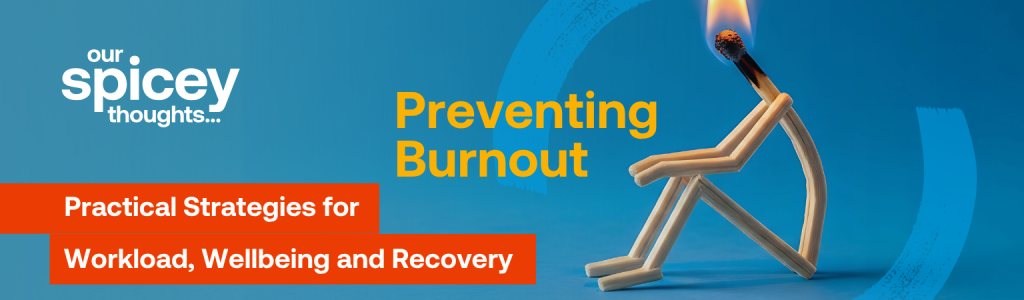
Preventing Burnout: Practical Strategies for Workload, Wellbeing and Recovery

Burnout rarely announces itself with dramatic fanfare.  More often than not, it sneaks in disguised as a busy month. 

Someone stays late to get a project over the line. Another person picks up a few extra tasks because a colleague has left. A manager starts doing more themselves because it’s quicker than delegating. Everyone agrees things are “a bit hectic right now” but assures each other it will settle down soon. 

Then three months later, nothing has settled down. 

The extra work has become normal work. The person who was “helping out” now seems to permanently own half of someone else’s role, and the employee who has always been wonderfully dependable is suddenly exhausted, disengaged or seriously considering whether life might be better somewhere with fewer Teams notifications. 

That’s when burnout can start looking like an individual wellbeing issue.  However, often, it isn’t. 

Very often, it’s a sign that something in the way work is structured, managed or communicated needs attention. 

Burnout doesn’t begin with burnout 

By the time someone tells you they’re burnt out, there has usually been quite a long runway leading up to it.  Maybe their workload has grown gradually without anyone stopping to reassess what is realistic. 

Maybe their priorities change every five minutes, so everything is urgent and nothing ever feels finished.  Maybe they’ve stepped into a new role without enough training, or their Job Description bears only a passing resemblance to what they actually do each day.  Or perhaps they’ve been signalling for a while that they’re struggling, but those signals have been interpreted as complaining, poor time management or simply “part of the job”.  This is why burnout prevention needs to go further than wellbeing initiatives. 

Yoga is lovely. Fruit bowls are nutritious. Employee Assistance Programmes can provide valuable support.  However, none of them will fix a role that has become impossible to perform within a reasonable working week. 

So how do you get things back on track?  One of the simplest places to start is role clarity. 

Start with the work itself 

When people know what they are responsible for, where their authority sits, what their priorities are and what good performance looks like, work is generally easier to manage.  When they don’t, things get messy surprisingly quickly.  You end up with duplication, gaps, people stepping on each other’s toes, employees taking on work because they’re not sure who else owns it, and managers discovering that three people thought somebody else was dealing with something important. 

A current, meaningful Job Description is useful here, but only if it reflects the actual role. 

If your JD says “other duties as required” and it’s those other duties that now occupy about 60% of your week, we may have moved beyond “other duties”! 

Regularly reviewing roles, responsibilities and decision-making authority helps organisations spot workload creep before it becomes a genuine wellbeing problem.  It also makes conversations about capacity much easier. 

Instead of “I’m really busy”, the discussion becomes “these are my agreed priorities, these are the additional responsibilities that have been added, and something now needs to move”.  That’s a much more useful conversation for everyone. 

Keep talking before things go pear-shaped 

Good feedback and check-in frameworks create space for conversations about workload, priorities, support and roadblocks before they become significant problems.  Questions like “What’s taking up more time than it should?”, “What could we stop doing?” and “What are you carrying at the moment that I might not know about?”, can tell you far more than another traffic-light wellbeing survey. 

The annual performance review is not the ideal place to discover that someone has been drowning since February.  Managers need regular opportunities to understand how work is actually feeling, not just whether deadlines are technically being met.  Because your highest-risk person is not always the one visibly struggling.  Sometimes it’s the employee who keeps saying yes.  They’re capable. They care. They don’t want to let anyone down. So, they absorb the additional client, fix the problem, cover the vacancy and work a bit longer.  Which is fantastic.  Until it isn’t. 

The important bit, of course, is what happens next.  If employees repeatedly raise concerns and nothing changes, you haven’t created psychological safety. You’ve created a very efficient suggestion box. 

Sometimes people need more skills, not more hours 

Workload isn’t always about the sheer quantity of work.  Sometimes work feels overwhelming because the person hasn’t been properly equipped to do it.  This happens frequently when businesses grow quickly.  Someone gets promoted into management because they were brilliant technically, then discovers that managing people involves an entirely different skill set. 

A system changes and everyone gets a five-minute demo.  A role becomes more complex, but development doesn’t keep pace.  Then we wonder why people are working longer and feeling less confident. 

Training and Development Planning should therefore be part of burnout prevention too. 

If someone is taking twice as long to complete something because they’ve never been shown a better way, the answer isn’t necessarily “work harder”.  It may simply be “let’s teach you”.  Novel concept, we know! 

Psychological safety matters, but it has to be real 

One of the strongest protections against burnout is having a workplace where people can say: 

  • ‘This isn’t manageable’ 
  • ‘I need help’ 
  • ‘I don’t understand what you’re asking me to do’ 
  • ‘I think we need to rethink this’ 

That sounds simple. In practice, it depends enormously on how leaders respond. 

If the first employee who raises a workload concern is labelled negative, difficult or not resilient enough, everyone else receives the message loud and clear.  And suddenly nobody has a workload problem anymore.  Magic! 

Psychological safety doesn’t mean agreeing with every concern or immediately removing work whenever somebody feels stretched. Businesses still need accountability, performance standards and the occasional difficult conversation.  What it does mean is that people can raise genuine issues without fearing that speaking up will be used against them. 

That gives managers the chance to intervene early rather than discovering a problem when someone is already at breaking point. 

And sometimes, something genuinely has to change! 

There is also a point where no amount of coaching, prioritising or clever calendar management will solve the problem.  The business may simply have outgrown its structure.  Perhaps roles have expanded dramatically. Perhaps responsibilities are sitting in the wrong places. Maybe a vacancy was never replaced, and the work has quietly been redistributed forever. Or perhaps growth has created a level of complexity that the original team structure was never designed to handle. 

At that stage, telling everyone to be more resilient is unlikely to cut it.  Sometimes you need to reset workloads, redesign roles, redistribute responsibilities, recruit, remove lower-value work or restructure.  Those conversations can feel uncomfortable, particularly when an organisation is trying to keep costs under control.  But leaving an unsustainable structure untouched has a cost too. 

Eventually it shows up in absences, mistakes, turnover, disengagement, customer experience or the loss of exactly the people you were hoping would help you grow. 

Prevention beats picking up the pieces 

WorkSafe New Zealand treats psychosocial risks such as excessive workload, poor work design and workplace stress as workplace health and safety issues.  That means burnout prevention shouldn’t sit solely in the “nice things we do for our people” bucket.  It belongs in good business management. 

Health and Safety inductions and processes should help people understand how to raise concerns. Managers should know what warning signs to look for. Workloads and role expectations should be reviewed as businesses change. Leaders should be equipped to have conversations early, rather than hoping things sort themselves out. 

And if you’re looking around your workplace thinking, “Hmm. We may have normalised a few things we perhaps shouldn’t have”, that doesn’t automatically mean there’s a crisis.  It just means it might be time for a closer look. 

Add Spice 

At Spice, we help businesses get underneath the wellbeing conversation and look at what might actually be driving the pressure. 

That might mean tightening up Job Descriptions and role clarity, introducing better Feedback and Check-in Frameworks, building Training and Development Plans, strengthening Health and Safety processes or helping leaders create greater psychological safety within their teams. 

And when the issue is bigger than a few tweaks, we can also help with workload resets, role redesign and restructures.  Preventing burnout isn’t about creating a workplace where nobody ever feels busy. 

Busy happens.  It’s about making sure “flat out” doesn’t quietly become the permanent operating model. 

If you’d like to take a fresh look at workload, role clarity or the people processes sitting behind your team’s wellbeing, talk to Spice. 

Add Spice. Your People Partner. 

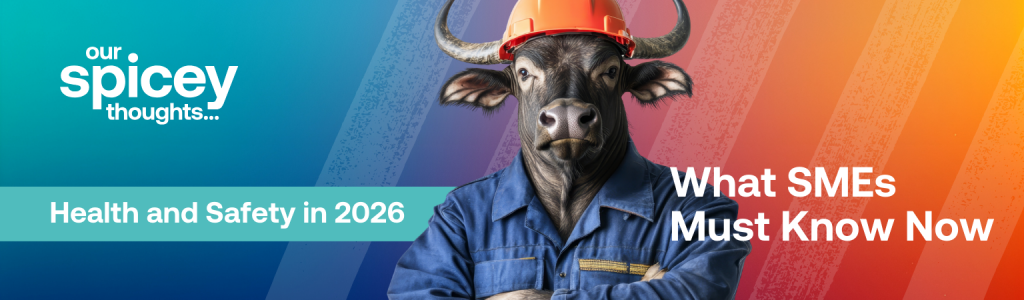
Health and Safety in 2026, What SMEs Must Know Now

We work with business owners and leaders across New Zealand every day, and if there is one consistent theme in health and safety conversations right now, it’s this, people are tired of tick box compliance.

Most SME owners genuinely want their people to be safe and well at work. What they don’t want is another generic template, another policy that no one reads, or another system that technically meets the rules but never quite makes it into day-to-day behaviour.

As we head into 2026, to date, we haven’t seen health and safety expectations getting lighter. Regulators continue to focus on real risk management, psychosocial wellbeing, and leadership accountability, not just paperwork. The good news is that when health and safety is done properly, it becomes far less painful and far more valuable.

From our perspective as HR and H&S consultants, the businesses that get this right are the ones that stop seeing health and safety as a compliance task and start treating it as part of their culture.

Moving Beyond Tick Box Compliance

The Health and Safety at Work Act 2015 has always been clear that managing risk is about what is reasonably practicable, not about how many forms you can produce. WorkSafe continues to reinforce that expectation, with an increasing focus on whether systems are actually implemented and understood, not just written down.

We regularly see businesses with thick H&S folders that look impressive, but when we ask staff how things work in practice, there is a disconnect. People are unsure what to do, hazards are managed inconsistently, and leaders assume compliance equals safety.

Our advice to business owners is simple. If your health and safety system does not reflect how work is really done, it will never be effective.

Practical, Tailored Documentation Matters

One of the biggest shifts SMEs can make is moving away from generic documentation and towards tailored, working material.

At Spice, our Tailored H&S Manuals and Working Documentation and Templates are built around your actual operations, risks, and team structure. That means policies that sound like your business, procedures that match real workflows, and templates that managers can actually use.

When documentation feels familiar and relevant, people engage with it. When it feels copied and pasted, it gets ignored.

Training That Sticks, Not Training That Ticks a Box

WorkSafe research shows that workers who receive relevant health and safety information and training are more confident and more engaged in managing risk. However, only around one third of New Zealand workers report receiving useful health and safety training in the past year.

This is where SMEs can make a real difference. Health and safety induction and training does not need to be long or complicated, but it does need to be meaningful.

We encourage clients to treat induction as the starting point of a conversation, not the end. Good H&S Induction and Training explains what safety looks like in your workplace, who is responsible for what, how to raise concerns, and why it matters.

Short refreshers, toolbox talks, and simple reminders throughout the year keep safety visible without overwhelming people.

Implementation Reviews Keep Systems Alive

Another common trap we see is the “set and forget” approach. Policies are reviewed annually because that feels compliant, but no one checks whether they are actually being followed.

Implementation Reviews are one of the most valuable tools SMEs can use. They help answer practical questions like, are managers confident applying the process, do staff understand expectations, are risks being managed consistently, and does the documentation still reflect how the business operates today.

At Spice, our implementation reviews focus on real world use, not just document compliance. This often leads to small, practical changes that make a big difference.

Clear Guides for Employees and Drivers

Employees, and particularly those who are out on the road, are often the ones exposed to the highest risk, yet they are sometimes given the least practical guidance.

Employee and Drivers Guides are an effective way to bridge this gap. These guides translate policies into plain language, outline common scenarios, and clearly explain expectations. They also help employees feel supported rather than policed.

From an HR perspective, these guides are a simple but powerful way to reinforce a safety culture without adding administrative burden.

Health and Safety as the Foundation of Wellbeing

Modern health and safety is no longer just about physical hazards. Psychosocial risks, workload pressure, and stress are increasingly recognised as critical safety issues.

Public Service Commission data and wider research show strong links between wellbeing, engagement, and safe behaviour at work.

When businesses treat health and safety as the foundation of wellbeing, rather than a compliance obligation, people are more likely to speak up, support each other, and take responsibility for risk.

Our advice to leaders is to model this visibly. Talk about safety, ask questions, follow through on concerns, and show that wellbeing genuinely matters.

Add Spice to Your Health and Safety Approach

As HR and H&S consultants, our role is to help business owners move from compliance driven systems to practical, embedded approaches that actually work.

Health and safety in 2026 is not about more paperwork. It is about smarter systems, better conversations, and leadership that treats safety as part of how the business operates every day.

From Tailored H&S Manuals and Working Documentation, to H&S Induction and Training, Implementation Reviews, and Employee and Drivers Guides, we help SMEs build health and safety frameworks that are practical, branded, and embedded into culture.

If your health and safety still feels like a tick box exercise, it might be time to rethink the approach.

Add Spice.

Building Trust and Psychological Safety, Beyond Buzzwords

If you have been in leadership for more than five minutes, you will have noticed that the phrase ‘psychological safety’ has become one of those workplace favourites. It shows up at conferences, in LinkedIn posts, strategy decks and the occasional team meeting where everyone nods enthusiastically, then quietly goes back to business as usual.

But genuine psychological safety is not built on slogans or laminated posters. It is built on the very unglamorous but potent combination of consistent leadership behaviour, clear communication and shared language. When you add solid Health and Safety foundations, predictable feedback rhythms and tools like Extended DISC, you create the conditions for people to feel safe, informed, respected and valued. That is when trust becomes real, not just an aspirational word written on a wall.

The real ingredients of trust

As a business owner or people leader, you already know that trust is the currency of teamwork. When trust is high, communication is easier, decisions are clearer and problems get solved before they turn into fires. When trust is low, everything takes longer, frustrations simmer under the surface and leaders find themselves firefighting instead of leading.

Many workplaces rely on good intentions and hope, but trust is built on repeatable behaviours. Think of it like your Health and Safety programme. You do not hope people will lift safely, you teach them how. You do not hope they will report hazards, you create systems and expectations.

The same structure applies to psychological safety. People feel safe when:
• Leaders follow through consistently
• Communication is clear, honest and timely
• There is a shared language for how we work together
• Feedback is regular and predictable rather than something delivered only when there is a problem
• Health and Safety processes remove confusion and reduce risk
• Teams understand each other’s preferred communication styles and stress behaviours

When these parts work together, trust stops being a fluffy concept and becomes something people can experience day to day.

Leadership behaviour, the deal maker or breaker

One of the most powerful drivers of psychological safety is what leaders do repeatedly. Consistency signals safety. Inconsistency signals danger. If your Monday message is one thing and your Wednesday behaviour is another, your team will notice, even if they never say so out loud.

This is why so much of our work with clients begins with Acentia Culture Workshops and Leadership Capability sessions. These workshops help teams define what behaviour looks like in practice. Not a list of values written in corporate jargon, but clear expectations built from the inside out.

When leaders demonstrate reliability, fairness, curiosity and transparency, people feel secure. When leaders communicate clearly, hold good one on one conversations and give regular feedback, people feel seen and supported. It is the small everyday actions that create trust, not the once a year town hall.

Shared language, the underrated superpower

If you have ever worked with a team that misinterprets each other often, you know how exhausting it can be. Extended DISC® Effective Communication and Team Collaboration workshops give teams a shared language so they can understand each other in a way that is practical and non judgemental.

Extended DISC® awareness helps people read the room, adjust their communication and understand why someone else might respond differently to the same situation. Suddenly, a colleague’s bluntness is not rudeness, it is a D style communicating efficiently. A teammate’s hesitation is not resistance, it is a C style wanting clarity and time to process.

This shared language removes friction and builds trust faster because people stop filling the gaps with assumption. Instead, they communicate with intention.

Feedback rhythms that reduce anxiety

Nothing elevates heart rates quite like a calendar invite titled Quick Chat from your manager. When feedback is sporadic or only delivered reactively, people feel more anxious and less safe.

Structured feedback and one-to-one frameworks remove that uncertainty. When people know when feedback is coming, how it is delivered and what the conversation is meant to achieve, they stop worrying and start engaging.

Regular one to ones build momentum, strengthen relationships and give people a sense of direction, and the feeling that they are seen and valued. Predictability equals psychological safety. It also reduces the emotional load on leaders, because issues are handled proactively, not stockpiled until they explode.

The Health and Safety connection people often overlook

In New Zealand, Health and Safety responsibilities are non-negotiable. What many organisations miss is that psychological safety and physical safety sit side by side.

Solid H and S systems create clarity, which creates confidence. People feel safer when:
• Inductions are clear and consistent
• Risks are explained in plain language
• Training is easy to access and actually useful
• Documentation removes guesswork
• Processes are followed by everyone, including leaders
• Reviews are done with purpose, not as a tick box exercise

This is why a robust Health and Safety Framework is essential for trust. When physical safety feels organised and well managed, people naturally feel more secure psychologically.

What New Zealand research tells us

The 2024 NZ Workplace Wellbeing Report shows that only around half of Kiwi workers feel safe to speak up when something is not right. Workers who reported high trust in leadership were significantly more engaged, more productive and less likely to be considering leaving their roles.

Trust is not a nice to have in the business context. It drives retention, wellbeing, psychological safety and performance. People cannot do their best work if they feel judged, ignored or unsafe to raise concerns.

Bringing it all together

When you combine leadership consistency, shared language through Extended DISC®, clear communication, structured feedback rhythms and a strong Health and Safety foundation, you reduce uncertainty and increase confidence. That is the true formula for psychological safety.

The good news is you do not need massive programmes to get started. You just need the right structures and the willingness to lead with clarity and humanity.

Where Spice can help

If your workplace is ready to turn trust and psychological safety into lived behaviours, we can support you through:
• Acentia Culture Workshops
• Extended DISC Team Collaboration Sessions
• Feedback and One to One Frameworks
• Health and Safety Framework design including manuals, inductions, training, documentation and implementation reviews

We help you take the mystery out of culture and make it something you can actually build, not just talk about. If you want a workplace where trust is strong, communication is honest and people feel genuinely safe to bring their whole selves to work, get in touch. Let us help you Add Spice